Insights, Products
How to choose the right SMS provider and evaluate their performance

When it comes to reaching customers, SMS still sets the standard. It’s instant, highly engaging, and simple to plug into your tech stack.
But its real value goes deeper. SMS supports everything from order confirmations and appointment reminders to OTPs and fraud alerts. With so much riding on it, choosing the right SMS provider isn’t just a technical decision – it’s a strategic one.
Sinch’s research shows SMS remains one of the most widely used communication channels across industries. It works because it’s simple, direct, and nearly universal. But that reliability depends on the provider behind it.
If you want SMS to remain a reliable channel with unprecedented reach, you need an SMS provider that’s also a partner you can trust.
So, what should you evaluate when you’re trying to choose the right SMS provider? Let’s look at eight important factors and key questions to guide your decision making.
Eight considerations for choosing the right SMS provider
1. Ease of integration
Key question: How easily can this SMS provider integrate with the systems we already use?
Your messaging platform needs to plug into your existing systems without creating months of engineering work. That means well-documented APIs and SDKs in the languages your team already uses.
Look for providers that offer developer-friendly code for quick integration into your CRM, marketing automation tools, or customer-facing applications. Some also offer no-code web tools for teams without deep technical resources.
Sinch found that 46% of business leaders plan to improve how communications integrate with their tech stacks. Integration should be straightforward and your provider shouldn’t slow your team down.
2. Security and compliance
Key question: How does this SMS provider help us stay secure and compliant in practice, not just on paper?
Enterprise security is non-negotiable. You need a provider with certifications like SOC 2 Type II and ISO 27001. You also need them to support compliance with regulations like GDPR and the TCPA.
But strong infrastructure and certifications are table stakes. The real test is how the SMS provider helps you stay compliant in practice. The best partners help you manage your responsibilities around consent and opt-outs, navigate regional laws, and monitor for fraud and abuse.
Messaging channels are increasingly targeted by fraud schemes like Artificially Inflated Traffic (AIT), where bots generate fake SMS traffic to drive up costs and exploit delivery routes. Will your provider work directly with you to reduce the risks of AIT fraud?
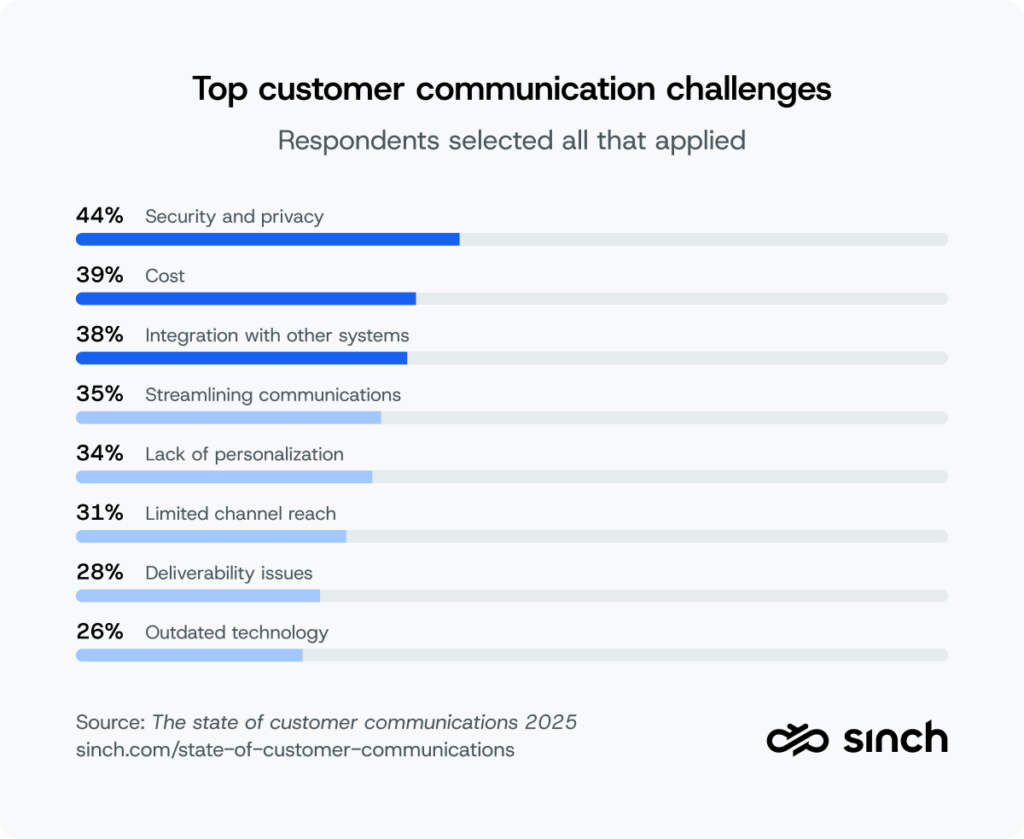
Sinch found that security and privacy topped the list of customer communication challenges across healthcare, financial services, retail, and technology. This should be a top priority when evaluating an SMS provider.
3. Delivery performance
Key question: Can this SMS provider ensure fast, reliable delivery across networks and regions?
A message that never arrives is worse than a message never sent. A message that arrives too late is almost as bad. You paid for it, your customer expected it, and the moment has passed.
Your provider’s delivery engine should consistently get messages delivered on time. That comes down to experience and direct carrier integrations.
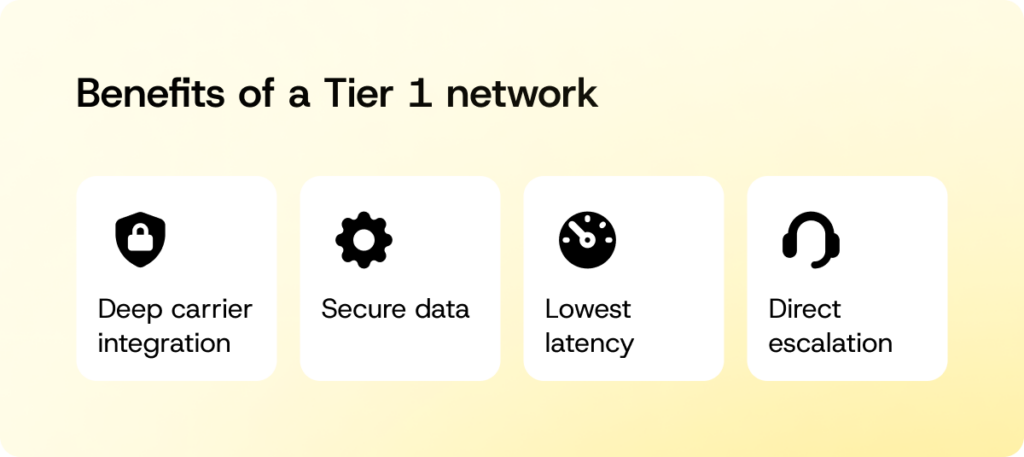
A Tier 1 Network provider delivers messages globally, rapidly, and securely over a single connection. That means direct integration into operator networks, lower latency, reduced costs, and better customer satisfaction. Tier 1 providers also get unique visibility into deliverability data, which allows them to adjust routing in real time based on carrier performance and availability.
The operational advantage compounds over time: better rates, faster issue resolution, and enhanced data security compared to providers routing through multiple intermediaries.
Providers with direct carrier connections (like Sinch’s global Super Network) can route messages more efficiently and adjust in real time. The result is faster delivery, fewer failures, and more consistent performance across global markets.
4. The power to scale
Key question: Can this provider scale with your messaging volume and channel needs?
Your messaging needs will change. Product launches, seasonal promotions, geographic expansion – all of these create spikes in volume and new requirements.
A scalable provider has infrastructure built to absorb those spikes without degrading delivery speed or message quality. If your provider struggles when volume doubles, you’ll feel it in missed messages and frustrated customers.
Your SMS provider should be part of a broader communications platform that can grow with these ambitions. This includes the ability to upscale your messaging strategy with RCS as well as the option to reach customers on OTT channels like WhatsApp.
Many brands are upscaling messaging to RCS. Sinch found 59% of business leaders across industries believe it will be game changing. They cite safer messaging experience as well as an increase in engagement and trust as the biggest benefits of RCS.
5. Two-way messaging
Key question: Does the SMS provider support conversational SMS?
One-way blasts have their place. But two-way messaging is the future.
Sinch found that 28% of consumers are frustrated when they can’t ask questions in response to a message they receive. For retailers, conversational messaging is already standard since 96% report using some form of two-way text marketing campaigns.
Two-way messaging opens up customer support, conversational commerce, appointment confirmations, and real-time feedback loops within the same channel your customers already use.
To support two-way messaging, you’ll need inbound numbers in each market you serve. Your provider should guarantee direct-to-handset delivery and let customers respond without friction. Check availability, pricing, and setup timelines for inbound numbers in each market before you commit.
6. Sender ID availability
Key question: Will your SMS messages look trustworthy when they arrive?
Your Sender ID is what recipients see when your message arrives and it directly affects whether they recognize and trust the message.
Options include:
- National numeric (a standard phone number)
- International numeric (with country code)
- Short codes (like 92250)
- Alphanumeric strings (like your company name)
Each type carries different trust implications and availability varies by market.
Alphanumeric and short code Sender IDs are generally perceived as more trustworthy. For sensitive messages – financial alerts, authentication codes, healthcare reminders and that trust directly impacts engagement and response rates.
The right Sender ID can close that trust gap before the customer even reads the message.
If two-way communication is part of your strategy, you’ll need numeric or short code Sender IDs, which limits your branding options. Plan accordingly.
7. Reporting and analytics
Optimization depends on visibility. That includes detailed reporting on delivery rates, message latency, and campaign performance along with delivery receipts to confirm whether individual messages reached recipients.
Aggregated data on sent vs. delivered volumes helps you track patterns and compare performance over time.
Real-time tracking matters for business-critical communications. If fraud alerts need to arrive within seconds (and 72% of consumers expect them immediately), you need visibility into delivery speed as it happens.
Another reason to consider upscaling to RCS is the additional insights available to senders. Unlike SMS, RCS provides analytics on metrics such as open rates and read rates.
8. Global expertise
Key question: Can this SMS provider serve as a partner with regional knowledge for global brands?
Sending SMS across borders sounds straightforward. The regulatory landscape says otherwise.
Different countries impose different rules on marketing messages, promotional timing, sender identification, and opt-in requirements. In some markets, sending a promotional text on a Sunday is illegal. In others, campaign provisioning can take four to eight weeks due to carrier approval processes.
Your provider needs in-depth country knowledge for every market you target. That includes:
- Local SMS features
- Sender ID support
- Compliance documentation
- Provisioning timelines
A knowledgeable provider prevents costly mistakes and keeps your campaigns compliant from day one.
Regional channel preferences also matter. WhatsApp dominates in Brazil and India. Line leads in Japan. iMessage and SMS share the US market. Your SMS provider should understand these dynamics and help you build a channel strategy that reflects how your customers communicate in each geography.
Beyond SMS: Why your provider should support RCS
SMS still plays a central role, but messaging is moving toward multi-channel experiences, and your provider should reflect that.
RCS (Rich Communication Services) brings branded, interactive, app-like experiences into the native mobile messaging inbox. Verified sender profiles with official logos and checkmarks build trust immediately.
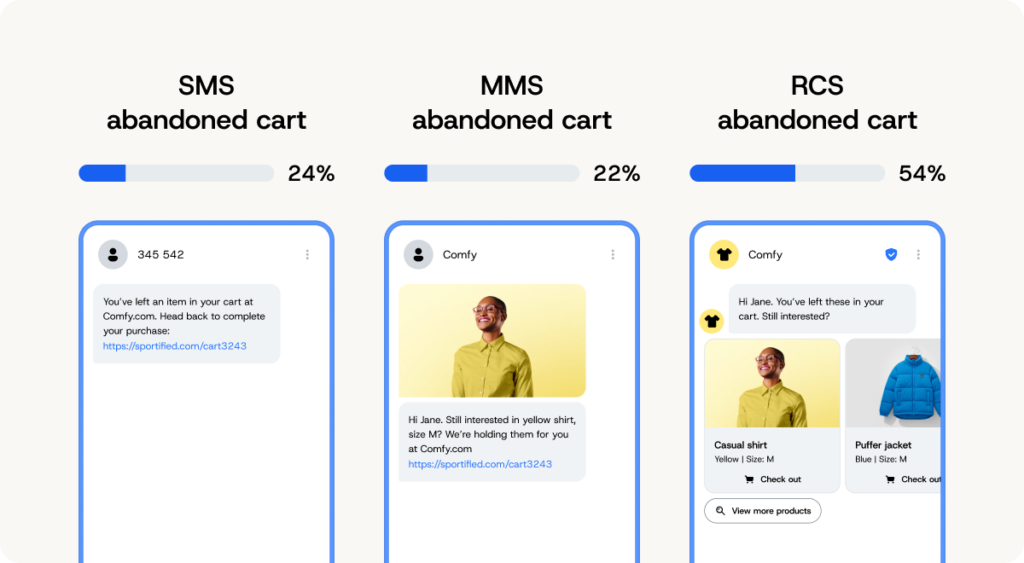
Rich cards, carousels, and action buttons drive higher engagement. Sinch data shows that 54% of consumers found an RCS abandoned cart message more engaging than either SMS or MMS versions.
59% also chose an RCS verification message as the most trustworthy option.
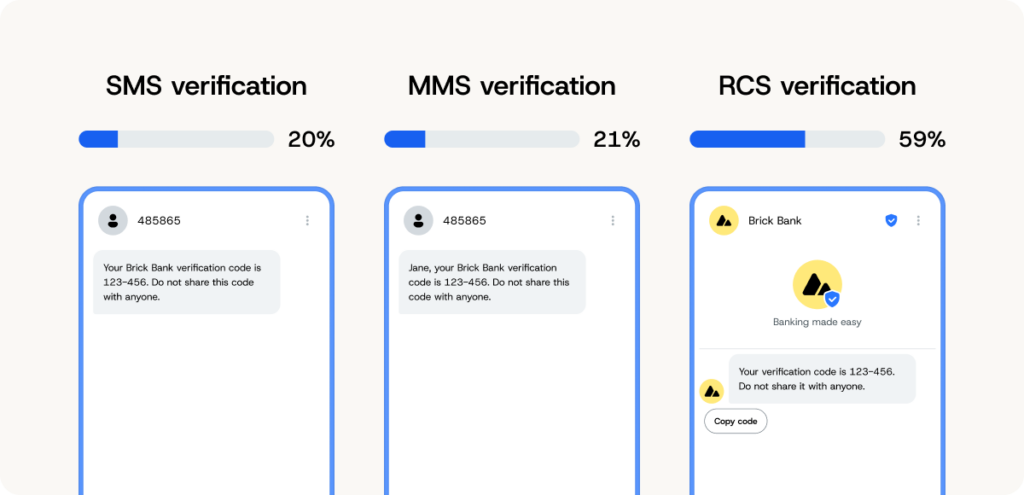
With Apple now supporting RCS on iOS and 87% of business leaders at least somewhat familiar with the channel, the window for early adoption is closing.
Look for a partner that can support both channels through a unified API, with SMS fallback for devices that don’t yet support RCS. That way, every recipient gets a message, and those on RCS-capable devices get a richer one.
How to evaluate your SMS provider’s performance
Once you’ve chosen a provider, the work shifts to ongoing performance measurement. Here are three areas to track.
Analyze delivery rates
Focus on delivery rate, speed, conversion rates, open rates, and other critical KPIs. If you’re running two-way messaging for customer engagement or support, response times and resolution rates matter too.
Benchmark against industry standards. SMS open rates consistently land between 90–98%. Click-through rates average 19–35% depending on industry. If your provider’s numbers fall significantly below these benchmarks, the problem may sit with routing quality or carrier relationships rather than your content.
Test API usability and integration quality
Your SMS API should work seamlessly across platforms and applications. Managing messages from one central system keeps communication consistent and reduces operational overhead.
Pay attention to documentation quality, error handling, and support responsiveness when issues arise. If your development team dreads working with the API, that friction will slow every campaign and product launch.
Measure time-to-market
Markets shift. Regulations change. You may need new numbers, new Sender IDs, or new market coverage on short notice.
Your provider’s ability to provision numbers quickly – especially inbound numbers in heavily regulated markets – directly impacts how fast you can respond. Ask about setup timelines and the support available during provisioning. A provider that helps you stay prepared and adapt quickly is worth the investment.
Finding the right SMS provider for your business
Message delivery is just the baseline. Your provider should also protect your brand, support compliance, and scale with your business.
Providers should pair reliable SMS delivery with support for RCS, conversational messaging, and AI-driven personalization so you’re not locked into a single channel.
For a deeper look at everything covered here, including an RFP template to guide your supplier evaluation, explore The Product Manager’s Guide to SMS.
Ready to see how Sinch can support your messaging strategy across SMS, RCS, and beyond? Contact our team to speak with an expert, or explore our SMS solutions to get started.

Author: