Products
What is MMS marketing? Benefits and how to get started
You’ve no doubt heard a lot about SMS marketing and may even be using it well. But what is MMS marketing, and how can it complement your SMS marketing efforts?
MMS marketing builds on the function of SMS by adding support for images, audio, video, and other visual media. It makes messages more engaging – without changing how people receive them. When you send a message as MMS rather than SMS, you can add more context and brand presence to each message for greater impact.
As email gained traction and mobile devices evolved, businesses looked for ways to include media in their text message communications. MMS made that possible, adding visuals to standard text messaging while still landing in the native text messaging inbox.
The value of sending MMS messages became clear fast: Combining media with the immediacy of text messaging helps brands stand out and deliver better customer experiences.
What is MMS marketing?
MMS stands for “Multimedia Messaging Service,” while SMS refers to “Short Messaging Service.” As the name suggests, MMS campaigns go beyond plain text, allowing you to send video, audio, photos, graphics, and GIFs to mobile devices.
With MMS marketing, you can do much more than drop a line of text with a call to action. You can enhance each marketing message with visuals that get attention, increase brand recall, and motivate a response.
In short, MMS messaging offers the same core benefits as SMS, with the added advantage of rich media and more characters for more expressive content.
SMS campaigns are limited to 160 characters per message, which may require you to have some serious editing skills and a gift for brevity. With MMS messaging, though, you can send up to 1,600 or 5,000 characters per message, depending on your provider. That means longer messages and room for compelling visuals in your MMS marketing messages.
Here’s a quick table comparing a few of the capabilities of SMS and MMS for marketing.
| MMS marketing | SMS marketing | |
| Character limits | Ranges from 1,600 to 5,000 characters with transcoding | 160 characters per message |
| Message formats | Supports text, video, audio, images, vCards, PDFs | Supports text with links |
| Costs | Higher | Lower |
| Response rates | Better | Good; can be around 45% |
| CTA buttons? | No (you can use images, but buttons are typical in RCS) | No |
| Customized photos? | Yes | No |
| Transactional and promotional messages? | Yes | Yes |
| Reach | All mobile users in supported countries (like Canada, the U.S., and Australia) | All mobile users (7.3 billion people and counting) |
MMS delivery can be impacted by file size and type, carrier support, device settings, and connectivity. You want to make sure not to include photos or videos that are too big or of unnecessarily high quality. Compress your multimedia content and don’t try to push the limits – keep media lightweight, so it loads quickly and displays well across devices.
Benefits of MMS marketing
You now understand the differences between MMS and SMS campaigns, but what are the advantages of MMS marketing? Let’s break down the benefits of using MMS as part of your marketing strategy.
Higher engagement
It’s simple: Visuals drive higher engagement. Whether it’s via photos, videos, animated GIFs, emojis, or fun and informative graphics with a clear CTA, visuals consistently outperform plain text when it comes to customer engagement.
And text messaging already has a strong edge. In fact, according to Sinch’s State of customer communications report, 30% of consumers want promotional messages delivered via text, and 41% of Gen Z said they want promotional text messages. Using MMS builds on that by making your text messages more compelling the moment they appear on a screen.
The result? Higher engagement rates, which can mean better conversion rates, too.
of consumers want promotional messages delivered via text message.
of Gen Z consumers want promotional text messages.
Instant deliverability
Text messages get delivered almost immediately after being sent. Most people see texts within a few minutes of receiving them because they have their phones with them. Compare that to email, which might sit unopened for hours (or longer), and it’s easy to see why text messaging is such a powerful tool.
Fast response data
Because texts get seen more quickly, your engagement rates will also show up much faster. Within an hour or two of sending the MMS message, you could have your response data in hand and use it to help inform your next move.
Better storytelling
Need to share product benefits, highlight a new feature, or paint a picture of a problem your product solves? MMS gives you room to do it. With support for visuals, audio, and longer messages (up to 5,000 characters depending on your provider), you’re not limited to a few lines of plain text. You’ve got space – and media – to tell a richer story.
Greater brand recognition
Your brand isn’t just your name – it’s your logo, color palette, and visual tone. Using MMS, you can embed all of that into your messaging. Visual identity builds trust, and consistent branding across channels reinforces that recognition over time.
Better customer experience
According to our State of customer communications report, more than 70% of consumers expect brands to personalize their communications, and 54% say personalized rewards and loyalty messages are the most valuable. MMS makes it easier to deliver that value visually – from tailored product images to location-specific reminders.
Perhaps that’s why more than twice as many consumers prefer MMS to SMS for appointment reminders. The visual impact of MMS elevates the better customer experience, and that’s what drives customer loyalty, positive reviews, and more.

When to use MMS for marketing
If a visual element could enhance your message, it’s worth using MMS instead of relying solely on SMS marketing. Sometimes, text-only messages are simpler, and they work. But if you’re aiming for higher engagement, greater click-through rates, and stronger conversions, it’s time to use MMS marketing.
The ability to include photos, videos, and other multimedia content makes MMS a smart choice when you want your text message to stand out.
Here are some campaigns where the expanded capabilities of MMS can outperform traditional SMS.
- Product launches: New product launches are much more effective when they feature a photo or video of the product. A photo or short video of the product helps capture attention and makes the message more memorable. First impressions matter, and using MMS ensures your audience sees exactly what you’re offering.
- Informative content: MMS allows you to use more characters for detailed messages – not to mention the option for videos and graphics. You could create a how-to video or provide a step-by-step list of instructions, and then include a link to a web page with more details.
- New sales announcements: Launching a new campaign? Liven it up with graphics and other multimedia content. Create graphics to highlight discounts, deals, special offers, and drive urgency that plain text just can’t match.
- Welcome messages: Welcome texts and emails typically get high engagement, but you can take that to the next level by using MMS messages. Add a photo, branded graphic, or short animation to give new subscribers a warm, memorable introduction to your brand.
- New promotions: Product photos, for any promotion, will garner more engagement than text alone. With MMS message, you can include images of a product catalog that links to your shop. It’s a smart way to blend the reach of a promotional SMS campaign with the depth of a visual campaign.
- Event promotions: Whether you’re promoting a webinar or an in-store event, MMS can help your event invitations stand out. Share images of the venue, teaser videos of the speakers, or a visual schedule. This can boost both interest and attendance.
- Mobile coupons: Coupons via mobile marketing are effective, but visuals can make them feel more tangible. Even something as simple as a coupon graphic can boost credibility and click-throughs over plain text.
- Holiday and seasonal greetings: Holidays are packed with imagery. From Valentine’s hearts to Black Friday banners, seasonal visuals evoke emotion and boost attention. Use MMS text marketing to make the most of these high-volume periods and improve campaign performance.
- Appointment reminders: Reminders, confirmations, and notifications work even harder when you use MMS marketing. Include a branded image, location map, or staff photo to make your message more effective, especially if you’re relying on automation to streamline the customer experience.
- Loyalty campaigns: When reaching out to your VIPs, visuals help personalize the message. A recognizable badge, membership graphic, or seasonal reward banner tells customers, “This is just for you.” That relevance drives higher engagement and loyalty.
MMS makes all these campaigns more impactful visually, emotionally, and strategically. If you’re looking for rich mobile marketing capabilities with stronger engagement than traditional SMS, use MMS text marketing to create experiences that drive action.
Want even more interactivity? Consider how MMS compares to RCS to see which channel fits your goals best.
Real-life MMS marketing examples
Any company can start using MMS marketing, but learning from those already doing it well can save you time and effort, and help you avoid early missteps. Let’s look at how successful MMS campaigns are already creating value in the real world.
GoLive: Compliant MMS for healthcare communications
GoLive enables secure, compliant mobile communication for their clients – including both one-way and two-way communication. While they started off in the healthcare industry, they’ve since expanded to several others.
In industries like healthcare, message deliverability is critical to service quality. And almost as important as deliverability is compliance with the many regulations associated with sending digital communications.
To meet both goals, GoLive partnered with Sinch in 2018 to ensure their SMS and MMS communications were reliable and fully compliant. Today, they confidently send more than 13,000 messages via MMS short codes and 100,000 via SMS short codes per month.
Glamour Shop: Personalized MMS for VIP customer loyalty
As a leading beauty industry brand, Glamour Shop depends on loyal customers who return for the products they love, and the standout brand experience they expect. But they realized that email alone wasn’t cutting it to make that happen.
Email marketing has many strengths, but instant readability isn’t always one of them. In contrast, 82% of consumers check their text notifications within just five minutes of receiving a text.
And in the beauty world, visuals are everything. Plain SMS wasn’t enough. Glamour Shop needed the visual impact of MMS marketing, and turned to Sinch Engage to make it happen.
They now send personalized product reviews, promotions, and images via MMS technology from Sinch Engage. Through customized communication, they’re engaging customers with the right message at the right time, and the result has been higher response rates and a more memorable customer experience.
“We have a strong relationship with loyal customers, and having MMS lets us use what works best for the situation and our customers.”
How do you get more people to attend your music festival? Tell them which performers will be there, and make it exciting.
But that’s tough to do with simple texts. With SMS, you’re limited to 160 characters, which makes it hard to capture the energy and emotion of a live event.
Life is Beautiful music festival wanted to grow its contact list and drive more ticket sales. To achieve that, they used MMS to send images that showcased their concert lineups. These visual messages gave their target audience an instant glimpse of what to expect, and resulted in 25% of all ticket sales happening via their MMS campaign.
Oracle x Sureshot: MMS enablement in Oracle Responsys
Sureshot wanted to expand their offerings to include global omnichannel messaging, and in one instance with Oracle, enable MMS messaging for their customers.
With Sinch’s help, Sureshot developed an MMS messaging app for Oracle. Their global user base can now effortlessly interact with instant messaging that includes images and graphics.
MMS marketing best practices
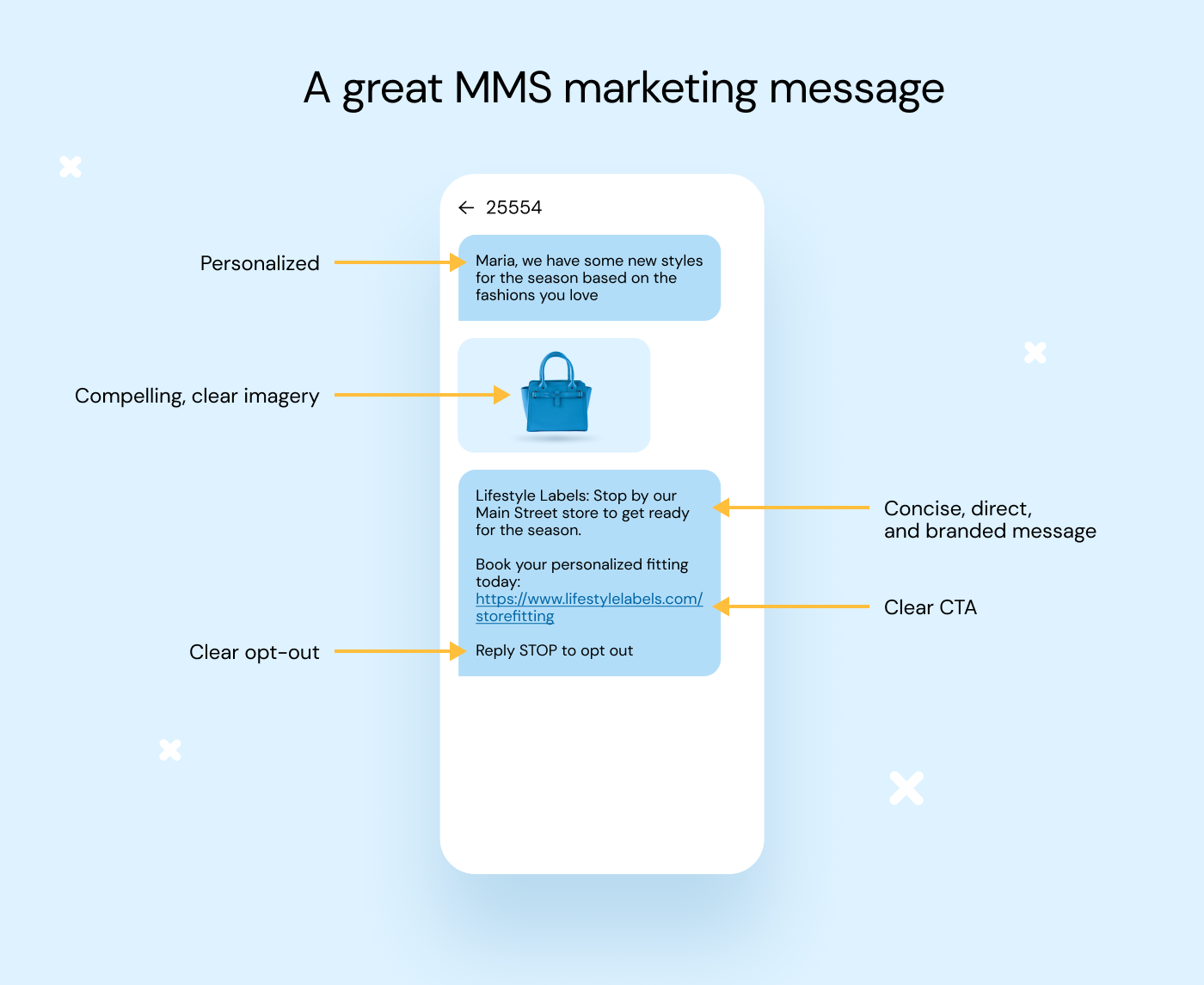
If you want to unlock the full potential of MMS in your text marketing, here are 10 best practices to help you optimize your campaigns for success. But first, let’s take a look at what a great MMS marketing message looks like visually.
1. Get permission and stay compliant
This one’s non-negotiable. Never send text messages without consent – the rules (and fines) are strict. Make sure you’re following opt-in best practices and keeping your list clean and compliant.
2. Design for mobile first
MMS is a mobile-first experience. Be sure your MMS messages are formatted for mobile devices, with visuals that display correctly on small screens. That includes checking placement, image ratios, and preview text.
3. Use SMS as fallback
Not every mobile device is enabled to receive and properly display MMS messages. In that case, what can you do? If an MMS message can’t be delivered, you can set up SMS as fallback so your message will get delivered.
4. Make the message relevant and personalized
The more personalized and relevant your MMS messages, the better response rates will be. Just like email, you can segment your MMS campaigns by demographics, purchase history, interests, and other factors. The good news is, sending personalized MMS messages is easier than ever.
5. Lead with compelling, visual content
Content is still king. If you’re going to create great MMS marketing campaigns, you need to have quality images, videos, graphics, and other multimedia to make it work.
And remember, pursue emotion. Create urgency, interest, intrigue, curiosity, desire, and the fear of missing out. Even with the best MMS campaigns, most people still don’t click. To motivate action, you need emotion.
6. Use a clear CTA
Just like in any piece of marketing, have a call to action that is direct, clear, and easy to grasp. You can use CTA text like:
- Order today
- Sign up
- Get your copy!
- Claim your coupon
7. Be strategic with timing and frequency
Even your most loyal customers won’t appreciate constant contact from you. Don’t bombard your subscribers with texts every day. Carefully consider how often they should receive MMS messages and which messages are most likely to resonate.
You can tie your timing to sales or key dates to avoid sending too many messages. For example, holidays, events, short-term sales and other initiatives have defined periods of time when they happen.
8. Use automation
Manual sends won’t scale. With automation, you can schedule multiple MMS messages, segment sends by audience, and stay consistent without burning out your team. Automation lets you do more, and do it smarter.
9. Set goals and measure performance
Every marketing campaign needs a purpose. Track performance metrics like engagement, conversions, opt-ins, and revenue. Over time, you’ll see what’s working and where you can improve your MMS marketing strategy.
10. Integrate MMS into your omnichannel strategy
MMS is just one channel to use in your omnichannel marketing plan. Your most effective form of media isn’t MMS, or SMS, or email, or social media, or any of the many other channels out there. It’s all of them.
Or it’s a combination of several that you’re using effectively and that are most relevant to your audience. Use MMS marketing to enhance your omnichannel marketing efforts so your subscribers, customers, and leads are hearing from you on all the mobile channels they love to use.
How to get started with MMS marketing
MMS marketing basically takes everything great about SMS marketing and enhances it. With greater engagement, more responses, and more versatility, you can do more and achieve more, all using basically the same technology. Here’s what you’ll need to start:
- Find your MMS technology platform.
- Choose the audience for your first MMS campaign.
- Develop the text, images, and graphics.
- Send out the campaign and monitor the results.
If you’re ready to get started with MMS marketing, let’s chat. Our team is excited to help you implement MMS marketing tactics that your customers will love!
MMS marketing FAQs
MMS stands for “Multimedia Messaging Service.” MMS enables companies and individuals to send text messages that include various forms of media. This is in comparison to the “Short Messaging Service” of SMS, which can only send text characters.
MMS is primarily supported in Canada, the United States, and Australia.
In theory, all modern smartphones, including iPhones and Androids, support MMS. However, some people have older phones that may not be able to send or receive them, or they might have restrictions from their carrier that limit what they can do with messages that require data.
With MMS you can send photos using jpg, gif, and png formats, videos in mp4, mov, and 3gp, audio with mp3, wav, and amr, and other files such as PDFs and vCards.
Other less common file types may also be possible, but they have to abide by file size restrictions, which vary by carrier. You can read through the maximum file size of MMS messages via Sinch on our community site.
Visuals are more powerful and effective at engaging human brains and emotions than words alone. For that reason, companies will get greater response and engagement using MMS in addition to SMS for their text message marketing. Use images and graphics that are relevant to the message, the campaign, and the customer, and the response rate will increase.

Author: