Insights
Why holiday returns need to be conversations, not just notifications

For retailers, Black Friday doesn’t end at checkout. Each return sets off a series of notifications to the shopper: the return confirmation with the label, the tracking updates, a note that the return has arrived, a shipping update for the replacement, or the refund notice.
And each of these steps typically raises questions: Can they get a replacement instead of a refund? Are the boots they ordered available in the next size up? How soon will the exchange ship? Some brands now send updates shoppers can simply answer.
In Sinch’s 2026 Black Friday and Cyber Monday consumer survey of 2,501 shoppers in eight countries, 93% said being able to respond to or interact with brands’ post-purchase messages was important.
Below, we look at what that means for retailers this season: how shoppers feel about no-reply updates, what they expect from post-purchase messages, and where AI fits in.
Online returns have long run on no-reply messages
This year, 53% of consumers said they planned to shop online during the holiday season, according to the National Retail Federation (NRF)’s 2026 holiday survey. Last year, retailers estimated that returns would total $849.9 billion, with 17% of holiday sales expected to be returned, according to the NRF’s 2025 Retail Returns Landscape report.
For these online returns, there’s no counter to walk up to. Every step happens through emails or texts, and many of those updates come from a no-reply address or number. If the shopper has a question, there’s nowhere in the thread to ask.
Of consumers surveyed in Sinch’s 2025 State of Customer Communications survey, 37% said their customer support interactions typically involve returns and exchanges. If shoppers could simply reply to the return update, many of those questions could be answered right there, without waiting in a phone queue or searching the help pages. And being able to reply is increasingly what shoppers expect.
Shoppers want more than static post-purchase notifications
Of all shoppers surveyed in our Black Friday and Cyber Monday survey, 61.3% called the ability to respond to or interact with post-purchase messages very important, and 31.4% somewhat important. For shoppers returning an order, it could mean replying to the shipping update of a replacement product to reschedule the delivery.
How important is it to be able to respond to or interact with post-purchase messages like order confirmation or shipping updates (e.g. reschedule delivery, confirm receipt, ask questions)?
Shoppers have wanted this for a while. Nearly 28% of consumers are upset when they can’t ask questions in response to a transactional message (Sinch, 2025).
When asked consumers whether they’d take advantage of the ability to make returns or exchanges from their phone’s default messaging app, 45% said yes, and 31% weren’t sure they’d use it but said they’d give it a try (Sinch, 2025). Younger shoppers were the most open, with 92% of Gen Z and 90% of millennials at least willing to try.
When a post-purchase update does take a reply, the message itself becomes the place to sort things out, and brands are starting to give shoppers that option.
More brands are opening the door to two-way conversations
In our Black Friday and Cyber Monday survey, 52% of shoppers said they’d noticed brands sending more two-way messages to their phones over the past year. This includes promotional messages or post-purchase updates shoppers can respond to, and customer service chats over channels like RCS or WhatsApp. Only 17% said they hadn’t noticed any increase (Sinch, 2026).
of shoppers have noticed an increase in two-way messages from brands
haven’t noticed any increase
The survey also suggests that shoppers who notice an increase in messaging conversations value personalization more. Among the shoppers who noticed significantly more two-way messaging, 91% said they value personalized messages, compared with 51% of those who hadn’t noticed any (Sinch, 2026).
For shoppers, a personalized return conversation is much more helpful. Since the brand already knows what they ordered, they can be offered the next size up or a similar replacement instead of a random suggestion. And if they reply with a question, they don’t have to explain which order they’re talking about, because the conversation already has those details.
Return updates don’t have to be plain text
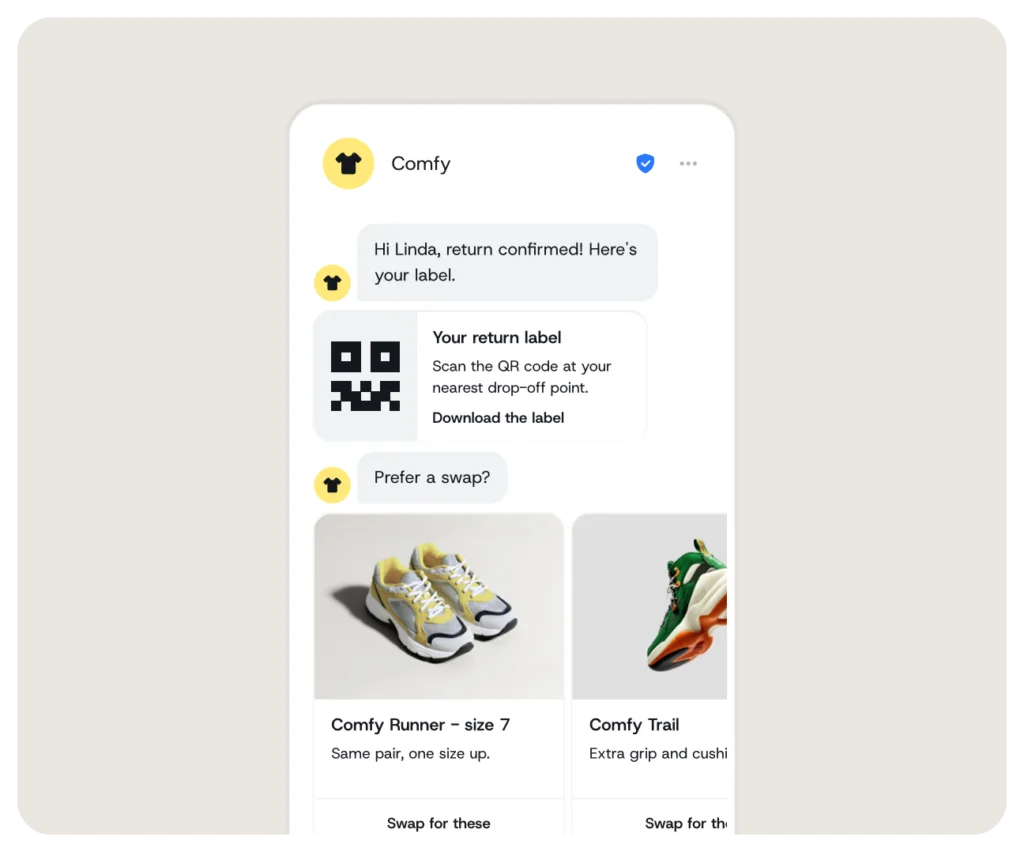
Our survey found that shoppers’ interest in interactive messages is growing: 52% said they’d engage with an interactive promotional message, up five points from 2025, while preference for plain text messages fell from 16% to 11% (Sinch, 2026). For shoppers returning a Black Friday order, an interactive update could show the return label, with buttons to choose a refund or an exchange in one tap.
So which communication channel should carry those conversations? This holiday season, there’s no single answer. When asked which channels they prefer for messages about a purchase, shoppers in our Black Friday and Cyber Monday survey picked email most often (72%), but 39% chose SMS and 28% WhatsApp (Sinch, 2026).
The channel also defines what a two-way conversation looks like. SMS works on almost any phone, and the shopper can type a text reply if the brand’s number accepts one. RCS, the upgraded form of texting, and WhatsApp can make conversations interactive, with rich media and suggested reply and action buttons that help move the return along.
AI is on the front line of two-way conversations
During the holiday rush, shoppers are likely to want their return questions settled quickly.
Much of a return conversation can be automated, and retailers are already putting AI into their conversations. In a survey of over 400 retail leaders across 10 regions, 63% of retailers reported they already have AI agents live (Sinch, The AI Production Paradox, 2026).
When asked in what situations they’d like to use an AI chatbot this holiday season, 33% of shoppers in our Black Friday and Cyber Monday survey picked getting support with returning an item. Asked about their confidence in AI for specific tasks, the picture changes: 81% said they’re confident it can handle order tracking. But for payment and billing, where a refund sits, confidence drops to 62%.
A big part of a return is logistics: getting the label, finding a drop-off point, tracking the package on its way back. These are the kinds of jobs shoppers seem comfortable handing to AI, but they might still want an easy way to reach a person when their money is at stake.
What’s at stake this returns season
The return experience shouldn’t be an afterthought. Every update can open a conversation or end a relationship. In NRF’s 2025 Retail Returns Landscape report, 71% of consumers said a poor return experience makes them less likely to shop with that retailer again. As conversational messaging becomes the expectation, this returns season will show shoppers which brands have taken notice.
At holiday volume, the infrastructure behind return conversations matters as much as the messages themselves. Sinch provides the foundation businesses need to keep up, on the channels their customers choose, when communications peak. Find out more about our communications infrastructure.

Author: